
Beyond the Funding Winter: What Makes an African Startup Fundable Today?
Why fundability now matters more than fundraising for African startups
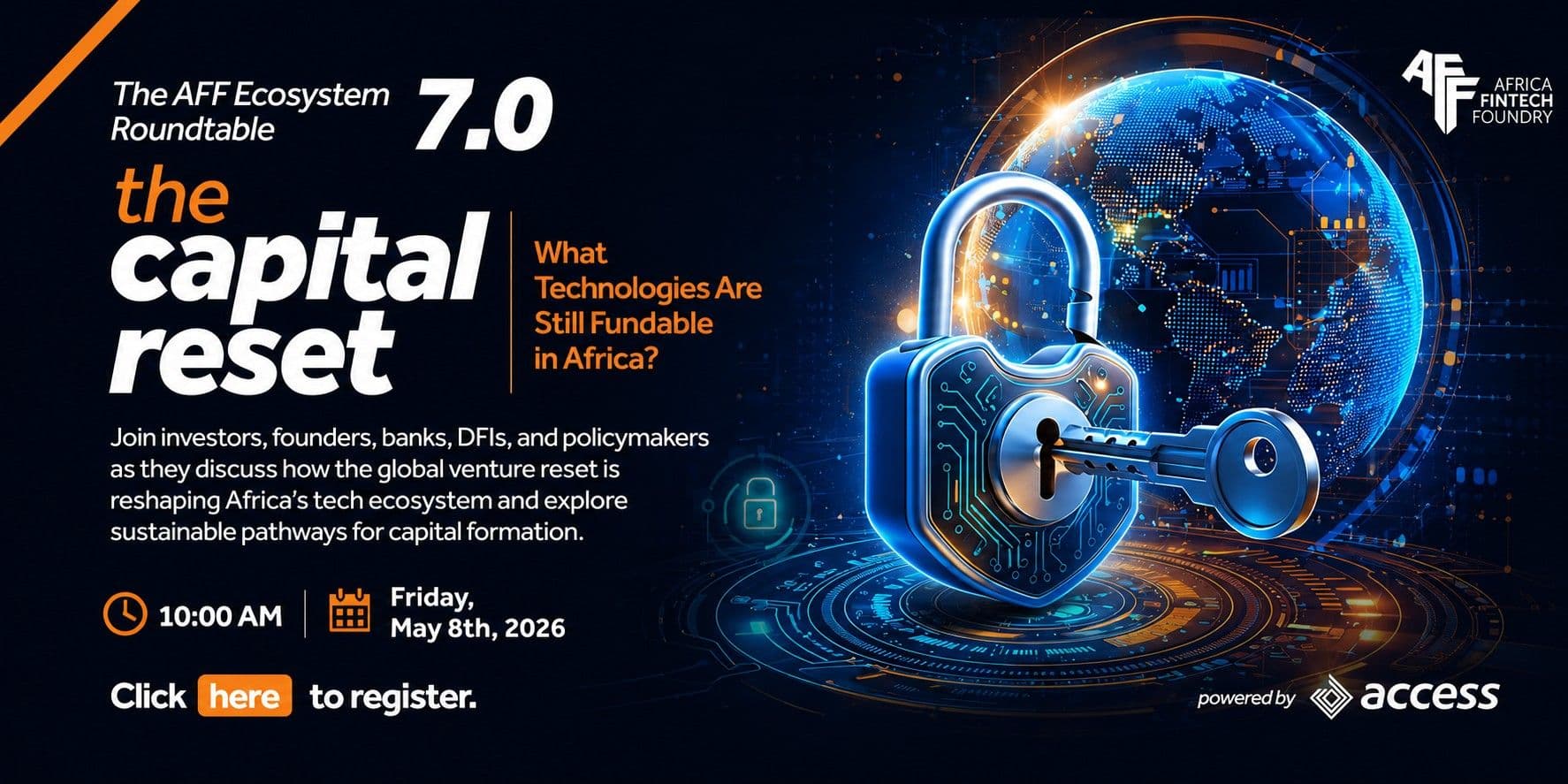
For years, the African startup ecosystem was shaped by a familiar playbook: build quickly, acquire users, demonstrate rapid growth, and raise the next round. Today, that playbook is being rewritten. On 8 May 2026, Africa Fintech Foundry convened Ecosystem Roundtable Talk 7.0 under the theme, Capital in a Shifting Landscape: Who Still Gets Funded and Why?
The virtual event brought together 21 speakers across four panel conversations, including venture capitalists, development finance institutions, founders, bank leaders, regulators and ecosystem enablers from across Africa.
The discussions explored one of the most urgent questions facing the continent’s innovation economy: when capital becomes more selective, what separates the startups that continue to raise from those that stall?
The Market Is Not Dead. The Rules Have Changed.
The most important message from the event was clear: capital has not disappeared from Africa. Instead, investors have changed how they evaluate opportunities. The growth-at-all-costs era is giving way to a more disciplined funding environment. Investors are looking beyond impressive user numbers and ambitious market projections. They want to understand whether a company has sound unit economics, responsible spending, a capable team, strong governance and a realistic path to profitability.
This means that growth still matters, but the quality of that growth matters even more. A startup may be expanding quickly, but investors now ask harder questions. How much does it cost to acquire each customer? Are customers staying? Is revenue recurring and predictable? Can the business survive without immediately raising another round? Is the company’s financial information reliable? In this new environment, traction must be supported by evidence.
Profitability and Capital Efficiency Are Now Entry Requirements
One of the clearest shifts discussed during the roundtable was the growing importance of profitability and capital efficiency. Previously, profitability was often treated as a future objective, something a startup would pursue after achieving scale. Today, investors increasingly expect founders to demonstrate a credible path to profitability much earlier.
This does not mean that every early-stage startup must already be profitable. It means founders must understand the economic engine of their business. They must be able to explain their margins, burn rate, customer acquisition costs, retention patterns and the milestones required to reach sustainability. Disciplined spending is no longer seen as a defensive response to difficult markets. It has become an indicator of strong leadership.
Governance Can Make or Break a Deal
Strong products and visible traction may attract investors, but weak governance can stop a transaction during due diligence. Clean financial records, clear ownership structures, appropriate spending controls, audited or reliable management accounts and transparent cash-flow reporting are becoming non-negotiable. Investors also want confidence that a startup is supported by a balanced team rather than being overly dependent on one founder.
Governance is therefore not simply administrative work to be completed when a company becomes large. It is part of the company’s investment proposition. Founders who treat governance, compliance and financial controls as early operating disciplines are more likely to move through due diligence efficiently and build lasting investor trust.
The Capital Stack Is Bigger Than Venture Capital
Another important theme from the event was the need to look beyond traditional venture capital. Equity investment remains important, but it is not always the most appropriate form of capital for every startup. Depending on its stage, sector, cash flow and risk profile, a company may be better served by grants, venture debt, structured credit, revenue-based financing, bank-supported facilities or blended-finance arrangements.
The fundable founder must therefore understand the full capital stack. An early-stage company developing a high-impact solution may initially benefit from grants or catalytic capital. A revenue-generating startup may be positioned for revenue-based financing or venture debt. Asset-heavy businesses operating in agriculture, climate or infrastructure may require blended-finance structures that combine development and commercial capital. The objective should not simply be to raise money. It should be to secure the right type of money for the business.
Fundability is not built inside a startup alone. The roundtable highlighted the role of regulation, digital infrastructure and public policy in determining whether investors can confidently deploy capital. Clear licensing frameworks, effective identity systems, reliable payment infrastructure, open APIs, secure data exchange and cloud services all reduce uncertainty and make businesses easier to assess and finance.
A strong startup operating within an unclear regulatory environment may still struggle to attract investment. Conversely, better digital rails and policy clarity can make an entire category of companies more visible and investable. This places regulators, banks, infrastructure providers and ecosystem organisations at the centre of the funding conversation. Their work determines whether capital has both permission and a practical route to reach innovation.
What Founders Who Still Raise Are Doing Differently
The founders succeeding in the current market are not relying on compelling storytelling alone. They are combining strong narratives with operational evidence. They demonstrate genuine product-market fit through retention, repeat usage, contract value and customer growth. They maintain realistic financial projections and communicate risks honestly. They build complete teams, organise their data rooms early and cultivate investor relationships well before they urgently need capital.
They also understand that different investors define value differently. A commercial investor may focus on revenue and margins, while an impact investor may also consider jobs created, communities reached or measurable social outcomes. Successful founders learn to communicate the full value of their businesses without exaggeration. Their stories are ambitious, but their evidence is grounded.
From Accelerating Innovation to Accelerating Fundability
For ecosystem organisations such as Africa Fintech Foundry, the changing capital environment creates a broader responsibility. Accelerator programmes can no longer focus primarily on pitch preparation and demo-day performance. Startups must also be prepared for investment committees and due diligence. This requires support across financial controls, governance, regulatory readiness, data-room preparation, capital-stack planning and exit awareness.
The ecosystem must move from manufacturing more startups to building the conditions that make startups fundable. That shift could include fundability scorecards, mock investment-committee reviews, capital-advisory services, regulatory-readiness tracks and stronger partnerships with development finance institutions, banks, debt providers and investors
The Future Belongs to Better-Structured Startups
The funding landscape has become more demanding, but it has not become impossible. African startups can still attract capital. However, the companies most likely to succeed will be those that combine innovation with discipline, growth with efficiency and ambition with operational readiness.
The central lesson from Ecosystem Roundtable Talk 7.0 is that fundability is not a single pitch, metric or fundraising moment. It is the result of how a company is built, how its capital is structured and how the wider ecosystem enables trust. Africa does not lack ideas, founders or opportunities. The next stage of the continent’s innovation journey will depend on how deliberately it builds fundable businesses, and the systems that allow them to thrive.
Featured Speakers
Ecosystem Roundtable Talk 7.0 brought together a diverse group of investors, founders, development finance leaders, regulators and ecosystem builders to examine what fundability means for African startups in a more selective capital environment.
Featured speakers included: Tokunboh Ishmael of Alitheia Capital; Cyril Shonibare of TLcom Capital; Kamohelo Motaung of Launch Africa; Yinka Adewale of Nomba; Dr. Dotun Olowoporoku of Venture Platform; Deji Sarumi of Tech Hive Advisory; Moyo Babalola of Alitheia Capital; David Nwankwo, Founder and Managing Partner at FDN Advisory; Daniel Chenube of Antler West Africa; Abena Annie-Budu of MEST Africa; Lucy Kimeu of FSD Africa; Ade Omotosho, CEO of Cybervergent; Rakiya Mohammed, CEO of Digibit and former CIO of the Central Bank of Nigeria; Dr. Aminu Muhammad Lawal of NITDA; Sharon Umunyana of RISA, Rwanda; Babajide Oluwase, Co-founder of Ecotutu; Tunde Akinnuwa of Duplo; Dario Giuliani of Briter; Husein Merchant of Village Capital; Fiyin Ogunlesi of Regal Stone; and Gbenga Sesan of Paradigm Initiative.
Download the Fundability Architecture Whitepaper
The insights from Ecosystem Roundtable Talk 7.0 have been developed into AFF’s latest thought leadership publication, The Fundability Architecture: What Separates African Startups That Raise from Those That Stall.
The whitepaper expands on the central argument from the event: Africa’s startup market is not dead; it is being repriced. Capital has not disappeared, but investors are now asking harder questions about profitability, governance, capital efficiency, exit pathways and the wider infrastructure that makes startups investable.
Inside the whitepaper, readers will find a practical framework for understanding fundability across three layers: the startup, the capital stack and the foundation. It explores why profitability is now a qualifier, how governance affects due diligence, why founders must think beyond equity, and how policy, digital rails and ecosystem support determine whether capital can confidently flow to innovation.