
Africa’s startup funding market isn’t dead. It’s being repriced.
Why African startups stall: fundability, not funding, decides who raises
Overview
African startup funding fell from a $4.6 billion peak in 2022 to $2.2 billion in 2024. But this decline does not tell the whole story. Capital has not disappeared; it has become more disciplined, more structured and more demanding.
For founders, investors, policymakers and ecosystem builders, this shift requires a new question. Instead of asking, “Where can startups find more funding?” we should ask:
“What makes a startup fundable in today’s market?”
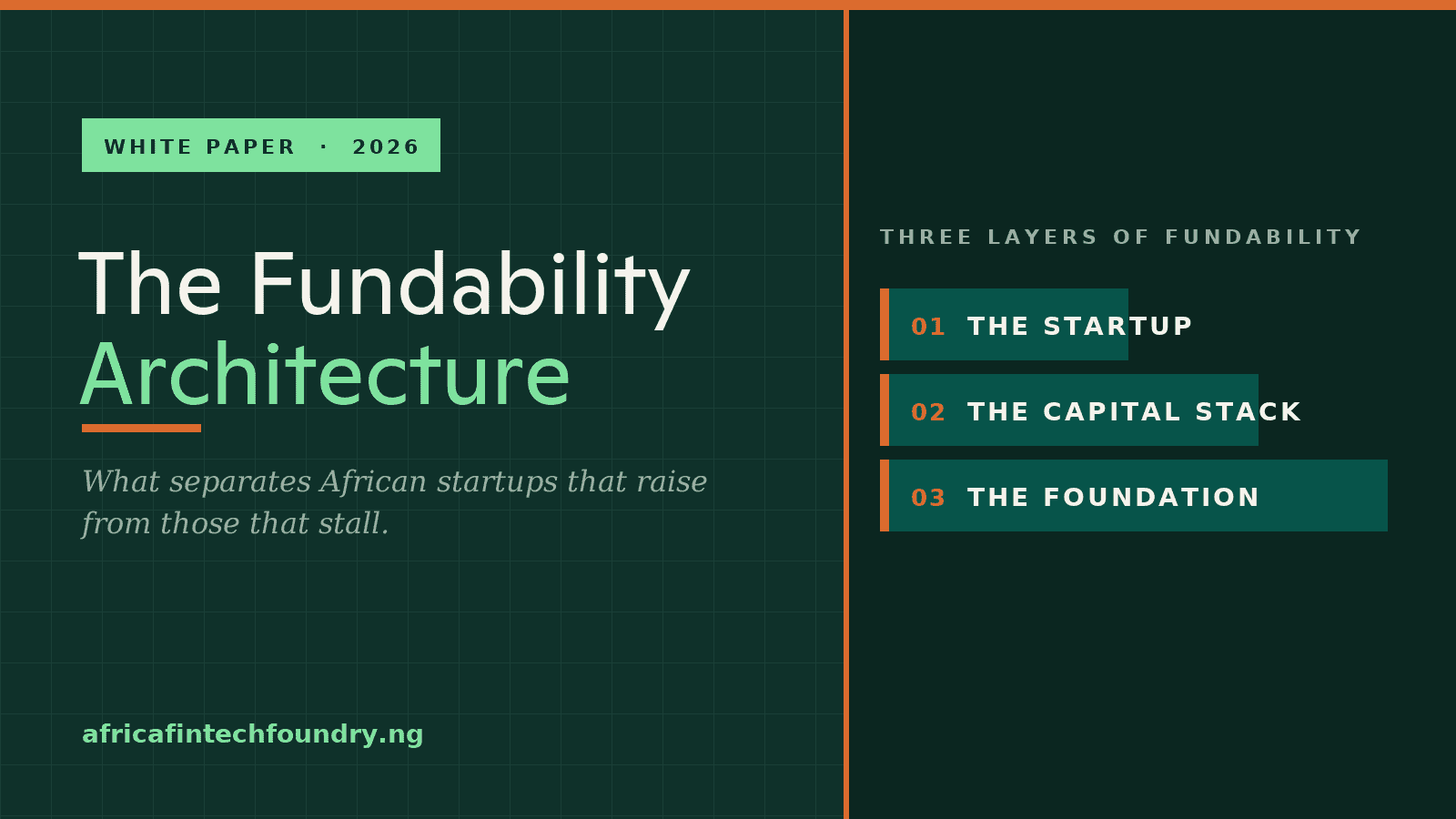
Africa Fintech Foundry’s latest whitepaper, The Fundability Architecture: What Separates African Startups That Raise from Those That Stall, explores that question and challenges some of the most persistent assumptions about Africa’s technology ecosystem.
Funding is no longer the real constraint
During the last investment cycle, rapid growth could compensate for weak margins, high spending, or immature governance. Companies were encouraged to capture markets quickly, with the expectation that another funding round would cover their losses.
That model depended on cheap capital and a high tolerance for risk. Both have changed.
Today’s investors want clearer evidence that a business can create sustainable value. Profitability, or at least a credible path towards it, is increasingly the price of entry. Clean ownership structures, reliable financial records, strong teams, and functioning boards are no longer administrative matters to be addressed later; they are central to investment decisions. This is the whitepaper’s central argument:
African startups increasingly stall not because there is no money, but because they lack the architecture required to attract, deploy and return capital.
Fundability is therefore much more than a compelling pitch deck. It must be built into the business and supported by the wider market around it.
The three layers of fundability
-
The first layer is the startup itself. Investors are looking for businesses with disciplined spending, credible economics, strong governance, capable management teams and a realistic understanding of how investors may eventually achieve liquidity. Founders must be able to demonstrate demand and withstand detailed financial, operational and legal scrutiny.
-
The second layer is the capital stack. Equity is no longer the only, or always the most suitable, source of finance. Founders increasingly need to combine equity with venture debt, grants, structured credit, revenue-based financing and blended capital. Debt represented 41% of African technology funding in 2025, illustrating how significantly the funding landscape has evolved.
-
The third layer is the foundation beneath the company. Regulation determines whether capital is permitted to reach a business. Digital infrastructure, including payments, identity systems, data exchanges and open-banking connections, determines whether it can reach that business efficiently.
A strong company operating in an uncertain regulatory environment or without reliable digital rails may remain effectively invisible to investors
What successful founders are doing differently
The whitepaper draws on the AFF Ecosystem Roundtable 7.0, which convened more than 20 practitioners from across Africa, including founders, investors, development finance institutions, regulators and ecosystem builders.
Their experiences reveal several consistent behaviours among founders who continue to raise capital:
- They establish relationships with investors long before opening a round.
- They present sustained evidence of customer demand and operational performance.
- They tailor their story to the priorities of each investor.
- They use grants and other instruments to validate and de-risk the business.
- They prepare for due diligence before fundraising begins.
- They raise from a position of strength rather than waiting until cash is running out.
The common thread is readiness. Investors are moving away from potential alone and towards businesses that can demonstrate disciplined execution.
The ecosystem must change its unit of analysis
Perhaps the whitepaper’s most important conclusion is that Africa cannot create a more investable technology market by focusing only on individual founders.
Accelerators and mentoring programmes can help startups improve, but they cannot substitute for clear regulation, accessible domestic capital, digital identity, interoperable payment systems or reliable routes to market.
The highest-leverage interventions often sit beneath the startup: opening institutional capital to alternative investments, using blended finance to reduce early-stage risk, building digital public infrastructure and making government procurement more accessible to innovative companies.
In other words:
We must stop manufacturing startups and start manufacturing fundability.
Download the whitepaper
The Fundability Architecture offers a practical framework for understanding who still gets funded in Africa, why others stall, and what every participant in the ecosystem can do differently.
For founders, it provides a playbook for profitability, governance, capital strategy, and investment readiness. For investors and development institutions, it identifies opportunities to expand the fundable market. For policymakers and ecosystem builders, it highlights the foundational conditions that allow capital to move.
Download the full whitepaper to explore how Africa can move from a fundraising market to a truly fundable one.